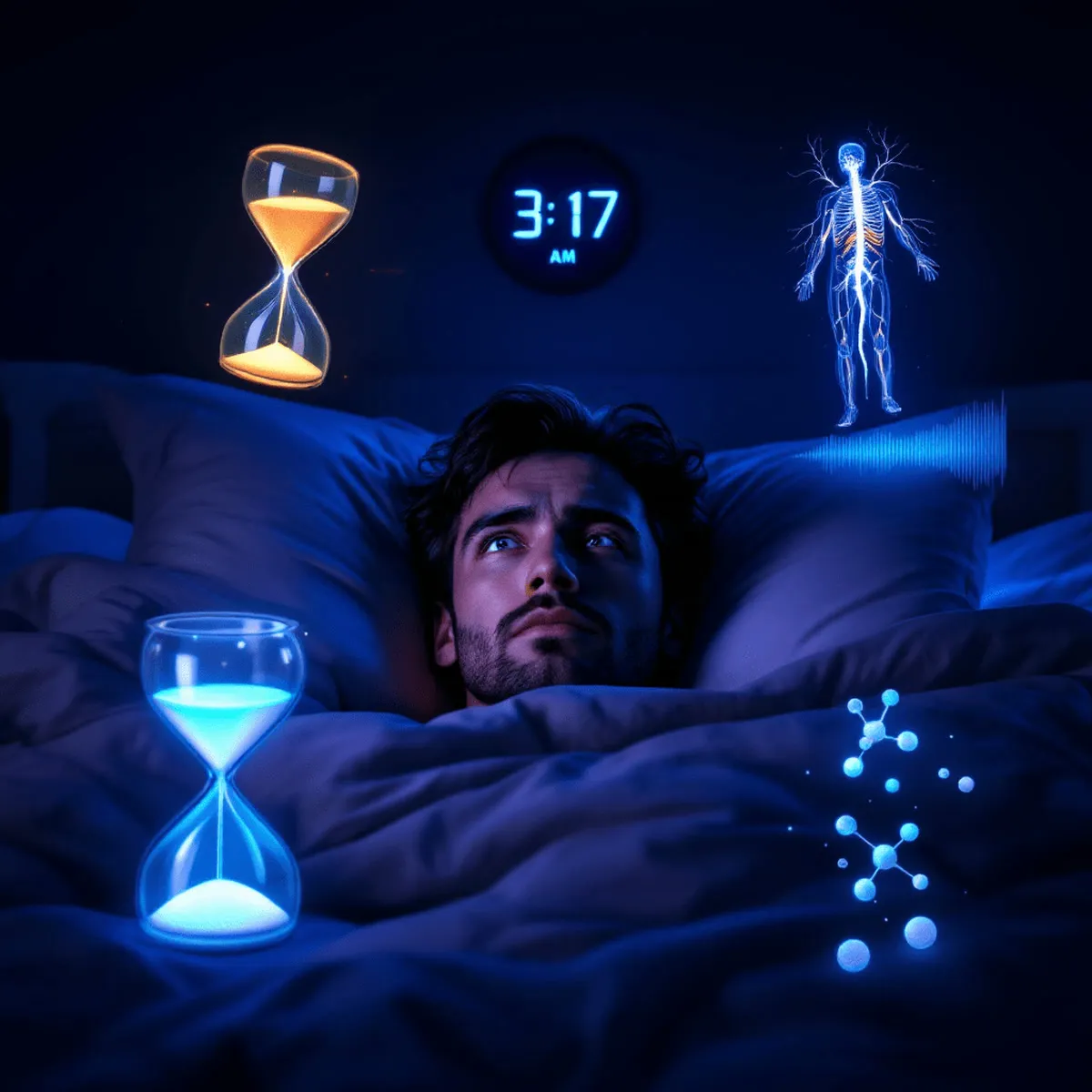
Why You Wake Up at 3:15 AM Staring at the Ceiling
It is 3:14 AM. The digital clock on your nightstand glares back at you with hostile green light.
You roll over. You check the time again. Now it is 3:15 AM.
Your heart is thumping against your ribs like a trapped bird. Tomorrow morning brings a stack of deadlines, breakfast to cook, and a calendar full of meetings where you will need every ounce of sharp cognitive energy you possess. Yet here you are, soaking in quiet adrenaline, actively calculating how many hours of sleep you might salvage if you somehow drift off in the next eight minutes.
I know that exact ceiling. I spent half of my early adult life staring at it, desperately rehearsing breathing exercises while growing increasingly enraged that they were not working.
When sleep refuses to cooperate, most advice tells you to buy blackout curtains, drink chamomile tea, or stop looking at blue light. If chamomile tea cured chronic 3:00 AM awakenings, the sleep clinic industry would not exist.
The real culprit behind recurring nighttime waking is rarely a lack of bedtime relaxation. It is a predictable neurological misfire known as autonomic nervous system hyperarousal. Once you understand the physical levers controlling that switch, you can dismantle the panic and let your biology take back control.
Why Standard Sleep Hygiene Fails You in the Middle of the Night
Sleep hygiene rules gained massive popularity over the past three decades for a simple reason. In an era when televisions moved into bedrooms and smartphones became permanent extensions of our hands, basic environmental cues did need fixing. Giving people a checklist of ambient light, ambient temperature, and evening caffeine cutoffs provided tangible things they could control.
Those rules help you fall asleep initially. They do almost nothing to keep you asleep when your neurochemistry shifts four hours later.
When you wake up in the pitch dark, following sleep hygiene rules often backfires. You lie rigid, terrified that twitching your toe or having a stray thought will violate your sleep routine. That rigidity signals genuine physical danger to your amygdala.
Instead of gently settling back into non-REM sleep, your brain assumes there must be a predator in the room because you are lying so frozen and vigilant. Your nervous system is doing exactly what millions of years of evolution designed it to do: protecting you from a threat you accidentally manufactured in your own head.
The Biological Levers Running Your 3 AM Alarm
Two physiological engines govern whether you stay asleep: your adenosine sleep pressure and your autonomic tone.
Think of adenosine as the physical exhaustion currency of the human body. Every minute you spend awake, your brain burns ATP for energy, leaving adenosine behind as a byproduct. Adenosine binds to receptors throughout the day, creating an invisible, heavy weight that pulls your eyelids down at night.
When you sleep for the first three to four hours, your brain clears roughly seventy percent of that accumulated adenosine.
This brings you to approximately 3:00 AM. Your sleep pressure is now much lighter than it was at 10:30 PM. Meanwhile, your natural circadian cortisol rhythm begins its slow, gradual ascent to prepare your body for dawn.
If your sympathetic nervous system—your fight-or-flight accelerator pedal—carries latent daytime stress, that slight dip in sleep pressure and mild rise in baseline cortisol collide. Your heart rate nudges up by four beats per minute. Your body temperature ticks up a fraction of a degree.
Your eyes pop open.
You are not broken. You have not forgotten how to sleep. Your internal accelerator pedal simply slipped into gear while your braking system was in the middle of routine maintenance.
The Heat Dump Secret
Your brain cannot transition into deep restorative sleep without a drop in internal core body temperature of roughly one degree Celsius (almost two degrees Fahrenheit).
The preoptic area of your hypothalamus acts as your internal thermostat. To cool down your core organs, your vascular system must pump blood to your extremities—your hands and your feet—where specialized vascular networks called arteriovenous anastomoses radiate that heat out into the atmosphere.
If your hands or feet are cold, or if your room is stiflingly humid, your blood vessels constrict. The heat stays trapped in your core. That trapped heat stimulates wakefulness pathways in your brainstem.
This explains why having freezing toes under a heavy duvet can keep you wide awake for two hours. Your core cannot vent its heat. Slip on a loose pair of warm wool socks or place a warm water bottle at the foot of your bed. Warming your extremities dilates those vessels, dumps your core heat into the air, and flips your hypothalamus back into sleep mode.
Nocturnal Glycogen Drops and Adrenaline Surges
There is another metabolic lever that frequently kicks in around 3:00 AM: hepatic glycogen depletion.
Your brain consumes approximately twenty percent of your body's total glucose supply even while you are fast asleep. During the overnight fast, your liver is tasked with releasing steady trickles of glycogen into your bloodstream to keep your cerebral energy levels stable.
If your evening meal was light on complex carbohydrates, or if you consumed alcohol before turning in, liver glycogen stores run dangerously low around the fourth hour of rest.
When blood glucose dips below a critical threshold during sleep, the brain encounters an emergency energy deficit. Because it cannot wake you up with a polite whisper, your endocrine system releases a sudden pulse of epinephrine and cortisol to trigger hepatic gluconeogenesis.
That pulse of epinephrine saves your brain from hypoglycemia, but it also slams on your sympathetic nervous system. You wake up with a pounding pulse, an uneasy sensation in the pit of your stomach, and a hyper-alert mind racing through unrelated worries. Recognizing this metabolic surge prevents you from misinterpreting a simple blood sugar dip as psychological catastrophe.
The 90-Minute Ultradian Rhythm Reality
Human sleep does not occur in a flat, unbroken eight-hour block. It operates in cyclic ultradian rhythms lasting approximately ninety to one hundred and ten minutes each.
At the tail end of every sleep cycle, your brain naturally ascends through light stage one sleep into brief moments of semi-wakefulness. Evolutionary biologists believe this was a vital survival mechanism, allowing our ancestors to scan their surroundings, ensure their shelter was intact, and adjust their physical posture.
In healthy sleepers, these micro-arousals last less than thirty seconds, and memory consolidation never records them.
The problem emerges when you become hyper-aware of this natural biological transition. You wake up during a scheduled ultradian shift, notice the darkness, and immediately panic: "Oh no, I'm awake again." That single spark of anticipatory fear ignites sympathetic arousal, locking you out of your next ninety-minute cycle.
STRESS IS YOUR ALLY: Mastering the Autonomic System
By Stuart Young | Published by Hot Fidelity Publishing
Tired of fighting your own physiology at 3:00 AM? This book gives you a calm, field-tested roadmap for understanding your nervous system's warning lights without biohacking fads or rigid dogma.
Managing the Single Immediate Decision
When you find yourself staring at that digital clock tonight, do not overhaul your entire life. Do not resolve to buy ten new supplements tomorrow morning.
Focus entirely on managing the single immediate decision right in front of you.
That single decision is simple: take the job of sleeping off your shoulders.
You cannot force unconsciousness through willpower. Willpower is an executive cognitive function, and executive cognitive function is the exact thing sleep turns off. Trying to force yourself to fall asleep is like pressing the accelerator while desperately pulling the handbrake.
Instead of demanding that your brain sleep, give it permission to merely rest. Resting in the dark with relaxed muscles and steady breathing delivers genuine physiological recovery. Your heart rate lowers, your skeletal muscles release tension, and your immune system continues its nightly repairs.
Try this somatic downshift right where you lie:
- The Double-Inhale Sigh: Take a deep breath in through your nose until your lungs are eighty percent full, pause for a split second, and sniff in one extra sip of air to fully expand your lung alveoli. Then let the air fall out through your mouth in a slow, unforced sigh. Repeat this twice. This single mechanical action immediately slows your sinoatrial heart node via the vagus nerve.
- Soften the Jaw: Let your tongue drop away from the roof of your mouth. Unclench the hinge of your jaw. Facial tension is the nervous system's quickest indicator of active conflict.
- Warm the Extremities: Slide on a pair of warm socks or place your hands under your pillow to facilitate peripheral heat transfer.
- Drop the Timeline: Stop calculating the hours remaining before your morning alarm. The human body is remarkably resilient. You can handle tomorrow even if you only rest quietly tonight.
Take one slow breath. Let the weight of your mattress hold you. Let tomorrow wait until tomorrow arrives.